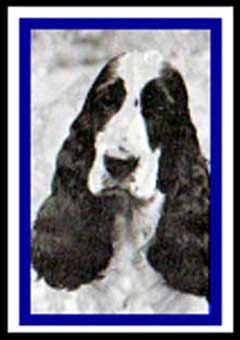
The Parti-Coloured Cocker Spaniel
The Cocker Spaniel is a breed that has a vast variation in coat colour and markings. As stated in the current RKC Breed Standard, colours of the Cocker Spaniel are described as Solid Colours and Particolours. In Solid Colours “a small amount of white on chest tolerated, but white in any other location highly undesirable.”. Particolours are subdivided into Bicolours, Tricolours and Roans.
The Parti-Coloured Cocker Spaniels' various colours are as follows :

Photo © Shel Cowles

Photo © Shel Cowles

Photo courtesy of Linda Reed


Photo © Jane Simmonds

Photo © Shel Cowles

Photo © Marion Sweeney

Photo courtesy of Jennifer Lloyd-Carey

Photo courtesy of Marion Sweeney

Photo courtesy of Cayley Turner
Some of the “& white” coloured cocker spaniels may have ticking of the dominant colour factor in their coat:

Photo courtesy of Elizabeth Craig
DEFINITION OF THE PARTI-COLOURED COLOURS
The roans are the most popular of the parti-coloured cocker spaniels and can vary from a light roan to a dark roan. The roaning is the flecking of the dominant colour in the coat, i.e. blue roan is black flecking, liver/chocolate roan is liver/chocolate flecking, orange roan is orange flecking.
The blue roan is the most popular of “the roans” and is followed by orange roan then liver/chocolate roan, the latter two colours are becoming more appreciated and people’s choice over a period of time could predict their status in popularity.
The "and whites" are predominantly white with small or large patches, and in some cases may have no body patches, of the pigmented colour i.e. black, liver/chocolate, orange.
The black & white is the most popular followed by orange & white then liver & white. People's choice over a period of time could predict their status in popularity.
The "and tans" are identified with definite patches of tan colour above the eyes, patches/flecking of tan around the muzzle, inside of ears, on the legs and feet, and under the tail area.
The blue roan & tan and black, white & tan are equally popular, followed by liver/chocolate, white & tan or liver/chocolate roan & tan, and again people’s choice over a period of time could predict their status in popularity. These coloured cocker spaniels are often referred to as “tri-coloured”.
In all the parti-coloured cocker spaniels, the areas of the main colour patching will usually cover the ears, both sides of the head and around the base of the tail.
There may also be markings of the main colour in the form of patches and these can be in small or large proportions anywhere else over the neck, legs, body and hindquarters.

Photo © Jefford

Photo courtesy of Carol Burnet
The breed standard does not state how the parti-coloured cocker spaniel should be marked, and in some cases there may be little colour patching on one or both ears or one or both sides of the head or body, and there may be no break in the main colour patching on the head – known as a blaze – so the head will be of the dominant colour.

Photo courtesy of Marion Sweeney

Photo courtesy of Elizabeth Craig

Photo courtesy of Shel Cowles

Photo courtesy of Jane Simmonds
There is no such thing as a mis-marked parti-coloured cocker spaniel – it is people’s choice on their preference of markings.
As puppies, parti-coloureds can be identified by the soles/pads of the feet: in blue roans and orange roans the pads are dark coloured – blue roans and orange roans with black pigmentation will be black, liver/chocolate roans and orange roans with liver pigmentation will be brown ; in the "and whites" the pads will be partially dark coloured – black & whites, black, white & tans and orange and whites with black pigmentation will be pink and black, liver/chocolate & whites, liver/chocolate, white & tans, orange & whites with brown pigmentation will be pink and brown.
Full and further information on all the colours of Cocker Spaniels is available on the website of The Cocker Spaniel Club (the parent breed club).